Conscious of the discriminatory practices and long-standing marginalization suffered by Romani people across Europe, in 2011 the European Commission adopted a Communication requiring Member States to develop national strategies for Roma integration and detailing the concrete policies and measures to be taken. On 28 February 2012, the Italian government adopted its National Strategy for Roma Inclusion (hereinafter, the Strategy) aiming to define the roadmap for public policies between 2012-2020, focused on the gradual elimination of poverty and social exclusion amongst marginalized Romani communities in four main areas: healthcare, education, employment and housing.
Regrettably, four years later and mid-way into the implementation period of the Strategy, Amnesty International, Associazione 21 Luglio and the European Roma Rights Centre remain severely concerned at the lack of progress achieved by Italy.
The human rights of thousands of Roma continue to be curtailed, particularly in the area of housing, as segregated camps, discrimination in access to social housing and forced evictions remain a daily reality for Roma living in camps in Italy. It is in this context that the undersigned organisations call on the European Commission to take decisive action to address these violations, constituting a breach of the Race Equality Directive, through the initiation of infringement proceedings against Italy.
Decades of discrimination, with no end in sight
For decades, Italian authorities have fostered residential segregation of Roma, and local and regional authorities persistently advanced “camps” as the only available and appropriate housing solution for Roma. In 2008, with the introduction of the so-called “Nomad Emergency”, Italian authorities targeted Roma communities with forced evictions, and pursued policies which fostered residential segregation. Such discriminatory policies persisted even after Italy’s highest administrative court, the Council of State, struck down this state of emergency in November 2011. The adoption of the Strategy followed and it was welcomed as a measure aiming at leaving the emergency approach in the past, and at advancing the protection of the rights of people belonging to one of Europe’s most marginalized communities.
However, the Strategy proved a short-lived hope. Over the years, our organisations have extensively documented the lack of progress and the continuation of past policies by Italian authorities across the country, preventing Roma from enjoying their right to adequate housing on equal footing with the rest of the population. This contradicts the spirit and letter of the Strategy and the country’s international and regional human rights obligations, including EU anti-discrimination legislation.
The persistent discrimination of Roma takes three main forms: segregation in mono-ethnic camps, often in substandard living conditions; discrimination in access to social housing; and forced evictions.
Camps as the only housing option for Roma
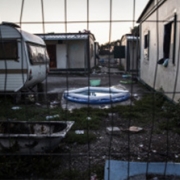
Thousands of Romani families currently live segregated in mono-ethnic camps set up by authorities across the country. Regional and municipal regulations enable Italian authorities to construct and administer Roma-only camps, which are often located in remote areas, far away from basic services, and sometimes unsuitable for human habitation, such as near waste damps and airport runways. Living conditions in camps are often inadequate, failing to meet international human rights standards and even national regulations on housing. Placement into camps is offered by the authorities to Roma only, often following forced evictions from informal settlements.
While the Strategy promised to “overcome camps”, stating that “the liberation from the camp as a place of relational and physical degradation of families and people of Romani origin, and their relocation to decent housing, is possible”, very little action has been taken by the authorities to this end. The “National table on housing”, established by the Strategy to address discrimination in access to housing, is still on paper only. No national plans have been drawn to provide for the promised process of desegregation from camps. On the contrary, in some cases authorities even planned and/or implemented the construction of new camps.
As recently as 4 February 2016 in Giugliano, Campania region, the municipal and Regional authorities jointly with Prefecture of Naples and the Ministry of Interior agreed to build a new camp with 44 pre-fabricated units for the Roma currently living in the “Masseria del Pozzo” camp. The “Masseria del Pozzo” camp was set up by local authorities in 2013 – over a year after the approval of the Strategy – to house Romani families who had already suffered a number of forced evictions. Families were then authorized to build their shacks in a remote area presenting serious health and safety concerns, due to the location’s proximity to landfills stocking toxic waste. Since then, living conditions in the camp have deteriorated and the camp has become uninhabitable, also due to problems with the sewage and water infrastructure. Due to the precarious and degrading hygienic and structural conditions of the camp, the judicial authority has recently ordered its seizure. In response to this, authorities are planning to set up a new camp a few kilometres away.
While it is clear that the families residing in Masseria del Pozzo need to be relocated away from the camp as a matter of utmost urgency, it is worrying that the authorities who put those families there in the first place, have not devised a plan for their long-term inclusion, and are instead offering to build and transfer them to yet another mono-ethnic camp. While 1.3 million Euros have already been designated by the Ministry of Interior and Region Campania for the pre-fabricated units, no funds have been secured for wider integration measures as envisaged by the project.
The case of Giugliano raises serious concerns and risks being yet another example of a segregated housing project for Roma. In previous years, other similar projects were carried out to house Roma in mono-ethnic camps, including the new La Barbuta camp in Rome.
Discrimination of Roma in access to housing
Segregation is compounded by the extreme difficulty Roma face when they are unable to access adequate housing. Many Roma have been effectively denied access to regular, unsegregated social housing, not only because of the lack of investments to increase the availability of affordable accommodation in line with the needs of the general population, but also due to the introduction by local authorities of criteria for access to social housing that directly or indirectly discriminate against Roma. In the face of such actions by local authorities, treating Roma differently to non-Roma on the basis of their racial and ethnic origin, the national government has failed to take action to address discriminatory practices.
For example, in Rome, people in need of housing are being treated differently depending on their ethnicity. For over a decade, a two-track assisted housing system has condemned thousands of Roma, and Roma only, to live in segregated, sub-standard accommodation in camps on the outskirts of the city. On top of the very limited availability of social housing for the general population, which is leaving thousands of families in need of housing stranded, Roma living in camps have been side-lined by allocation criteria which are impossible for them to meet. Rather than being helped to leave camps, Romani families willing to move towards other forms of housing are effectively hampered by authorities.
Forced evictions of Roma
The Strategy acknowledged the “excessive use” of evictions until that point, and how these were “substantially inadequate” to address the housing situation of Roma.
Despite this, Italy has continued to evict Roma from informal camps without the necessary safeguards such as consultation, adequate notice and others, in violation of the country’s international and regional human rights obligations and in contrast to other forms of evictions carried out in Italy. Romani families are often not provided with adequate housing alternatives, and they are instead often rendered homeless or placed into ethnically segregated camps or placed indefinitely into shelters for temporary accommodation. Roma are also sometimes forcibly evicted from authorized camps, when authorities decide to close them down, but do not offer inhabitants adequate alternatives, or when inhabitants disobey camps’ regulations. Many of these regulations inherently restrict Romani families’ freedoms and are not applicable to other forms of state-run housing.
Between March-September 2015, in the municipality of Rome, our organizations have documented a three-fold increase in the number of forced evictions of Roma compared to the previous year (64 operations in 2015, 21 operations in 2014). While the population of Roma living in informal settlements, according to estimates by the Department for Social Policies, counts 2,200 – 2,500 individuals amounting to 0.09% of the overall number of inhabitants, between 2013 and 2015 168 forced evictions affected around 4,000 Roma. Some of these people have been repeatedly forcibly evicted from their settlements and have had their shelter repeatedly destroyed.
The case of the Romanian Roma communities residing in the informal settlement of Val D’Ala park area is an illustrative and, regrettably, not isolated example. Inhabitants of the settlement were initially forcibly evicted on 9 July 2014. On 14 July 2015, the local authorities forcibly evicted the inhabitants again from the same location and rehoused part of the inhabitants in a Roma-only substandard reception facility. On 11 February 2016, the Romani families were forcibly evicted again, resulting in all people being rendered homeless in adverse weather conditions. All three evictions were carried out in absence of adequate written notice and led to loss of properties of affected families.
Will 2016 bring a wake-up call for the Italian authorities?
Four years since the adoption of the National Strategy for Roma Inclusion, thousands of Romani children, men and women are continuously faced with the denial of their right to adequate housing in Italy. While the Strategy pursues the right objectives – including an increased access to a range of housing solutions for Roma, in view of the need to overcome big mono-ethnic camps – it has clearly failed to achieve them. Crucially, it is not achieving concrete improvements in the lives of people belonging to one of the most marginalised communities in the country. Italian authorities need a wake-up call, as they continue to breach their own commitments as well as international and EU legislation.
For several years, numerous international and national organisations have voiced their concerns over the discrimination and segregation of Roma by Italian authorities. The undersigned organisations have also repeatedly called on the European Commission to use “infringement proceedings” to ensure that Italy effectively tackles such human rights violations. Segregation in camps, discrimination in access to social housing and forced evictions represent serious breaches of the Race Equality Directive, which prohibits discrimination in access to services, including housing.
Ahead of the anniversary of the adoption of the Strategy we are calling on the Italian authorities to put an end to the longstanding discrimination of Roma in access to adequate housing, and on the European Commission to swiftly escalate its involvement and use the legal instruments available to hold Italy accountable for violating rights guaranteed by EU legislation. As Junker Commission has placed high priority on enforcing EU law consistently, our organizations urge an infringement proceeding to be launched against Italy following many years of inadequate responses by the EU member state.