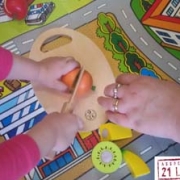
Toy for Inclusion vince il premio “Lifelong Learning Awards 2018”

Il progetto TOY for Inclusion, di cui Associazione 21 luglio è partner in Italia, riceve il premio “Lifelong Learning Awards 2018” lunedì 3 dicembre! Il premio viene assegnato dalla Piattaforma Lifelong Learning (Apprendimento Permanente) a iniziative che creano pratiche creative e inclusive.

L’edizione di quest’anno si concentrerà sul focus annuale della Piattaforma: “La Cultura dell’Apprendimento Permanente: una partnership per ripensare/riconsiderare l’educazione”.
La giuria ha selezionato 3 vincitori, uno per ciascuna delle tre categorie. TOY for Inclusion ha ricevuto il punteggio più alto nella categoria “Learning Environments/Ambienti Educativi”. Il premio è stato assegnato da una giuria d’eccezione.

Condividono e partecipano al nostro orgoglio e alla nostra gioia i nostri partner internazionali l’International Step-by-Step Association (ISSA) e l’International Child Development Initiatives (ICDI); e i sette membri di REYN: Istituto di ricerca educativa – ERI (Slovenia), Open Academy Step by Step – OASS (Croazia), Centre for Education Initiatives – CEI (Lettonia), Wide Open School – WOS (Slovacchia), Centre for Innovation in the Early Years – VBJK (Belgio), Associazione 21 Luglio (Italia) e Partners Hungary Foundation.

Annual Report 2017

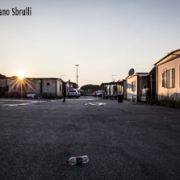
With its Annual Report, submitted on the occasion of the Roma and Sinti International Day, Associazione 21 luglio intends to focus on the condition of the Roma and Sinti communities that, due to institutional discrimination policies, are segregated in Italy as well as in the city of Rome in the so called “Roma camps”.
DOWNLOAD THE REPORT

early marriage

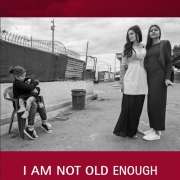
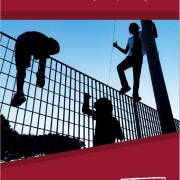
I am not old enough. Early marriage in Rome's slums

From Associaizone 21 luglio’s reasearch shocking data on the phenomenon of early marriage: in the Capital’s slums the rate reaches 77% exceeding the negative world record of Niger.
Download the report

matrimoni precoci

Early marriages: the rate reaches 77% in the Capital's slums

From Associazione 21 luglio’s latest research about early marriages, shocking data on the phenomenon: the rate reaches 77% in the Capital’s slums exceeding the negative world record of Niger. «It is essential to overcome slums in order to guarantee children rights».

ROME, 24 NOVEMBER 2017. In the world every year 15 million girls marry before reaching 18 years. In Italy studies and estimations about the phenomenon do not exist and early marriages are usually judged from a cultural point of view and attributed only to Roma communities or families of recent migration.
To quantify the phenomenon and understand the nature of these unions, Associazione 21 luglio realised the report “I am not old enough. Early marriage in Rome’s slums”, that will be presented today at 3 p.m. at the National Office against Racial Discrimination (UNAR) at the eve of the International Day against Women’s Violence.
The research was conducted in the extreme outskirts of Rome in 8 different housing locations (7 settlements and one occupied building), hosting more than 3.000 people, and considering the data of marriages contracted in the last two years (2014-2016). From the data collected, a shocking result emerged: on a total of 71 marriages, the rate of early unions is 77%, a number that exceeds the negative world record of Niger (76%) and by far the highest rates in Europe that are held by Georgia (17%) and Turkey (14%).
Out of a total of 142 individuals who married, nearly 72% married between 16 and 17 years old. 28% of those who married when they were still minors did so between the ages of 12 and 15. Gender influences highly the precocity in marriage: one girl out of 2 marries between 16 and 17 years old, one out of 5 between 13 and 15 years old.
The research stresses how the dynamics arisen during the interviews and the focus groups cross communities belonging to contexts far away from Rome’s slums and nevertheless affected by the phenomenon. The cross-over of early marriages witnesses that the socio-economic conditions of families have a strong influence on the issue, more than the cultural specificity of each group.  It is not by chance that early marriages register a double rate in rural areas than in urban ones and that a girl that attended only elementary school is double exposed to early marriage than a peer with higher education.
It is necessary to specify better about the link between early marriage and education: in the case of forced or combined marriages, the interruption of schooling paths is one of the most detrimental consequences of early marriage. When the marriage is chosen by the bride and groom (situation that corresponds to the 49% of the cases analysed in the research), instead, it is true the contrary: it is the failure of the schooling experience that contributes to steer the youth towards early marriage.
In a context of socio-economic deprivation such as Rome’s slums, characterised by the lack of external incentives and a very high unemployment rate, especially feminine, marriage is an opportunity to invest time, energies and capacities. The socio-economic disadvantage and the community’s conditioning, in a place where there is no space and too many people, become binding inside slums and foster that kind of practice.
«In order to guarantee children rights and promote a healthy childhood development, it is necessary a radical change in our country – Associazione 21 luglio declared – beginning with the need of combating urban and educational poverty through the overcoming of the slums located in the outskirts of the biggest Italian cities, places of segregation and socio-economic deprivation that hinder the enjoyment of children rights and of fundamental human rights».

Giornata Internazionale dell'infanzia

World children's Day 2017: in Italy 15.000 Roma minors are still living in slums

World Children’s Day. Associazione 21 luglio and REYN Italy: «15 thousand Roma minors living in Italian slums are deprived of rights. To reach real inclusion, it is necessary to combat ethnicisation in the policies».
In occasion of the World Children’s Day, Associazione 21 luglio and REYN Italy – active in the promotion of the rights and wellbeing of children – denounce the dramatic condition of the 15 thousand Roma minors living in formal and informal slums in the country. In Rome, it is estimated that 4.100 minors live in housing emergency and in poverty: 1.350 between 0 and 6 years of age, 2.750 between 7 and 18 years. The life of all these minors is signed by social exclusion, few access to health services and stigma. For these children life expectancy is 10 years below the average, in 1 case out of 5 they will not enter schooling paths and they will have almost 0 possibilities to go to university.
Housing conditions are the first obstacle encountered by Roma minors that affects their right to education. The majority of the slums are located far away from basic services, in extreme peripheries and in filthy and polluted areas. Lack of income, discrimination, social exclusion, cultural deprivation and inadequacy of the housing space are all factors that impact enormously on the physical and psychological wellbeing of the minors and cause the so-called “ghetto pathologies”: malnutrition, scabies, tuberculosis, anxiety and depression.
Forced evictions of informal settlements constitute traumatic events for children that live in slums, rendering families’ living conditions even more uncertain. They have also serious consequences on the right to education of children that suffer them. In Naples, in Gianturco neighbourhood, a forced eviction that involved 1.300 Roma in housing emergency (half of them were minors), caused a real diaspora just at the eve of the international Roma day on 8 April 2017.
In the Capital, since November 2016 there was an increase of 133% in the number of forced evictions.
«Recurrent ethnic policies have fuelled a circle of poverty and social exclusion, trapping disadvantaged families and becoming obstacles to the access to fundamental rights, such as housing and education – declared Carlo Stasolla, President of Associazione 21 luglio. REYN Italy is at work to promote a change in Italy aimed at fostering inclusive policies starting from early childhood characterised by quality and high professionalism».

Poster razzista Forza Nuova

Racist poster by Italian far-right party: open letter to Italian government members

Open letter to: Paolo Gentiloni, Italian Prime Minister, Andrea Orlando, Minister of Justice, Marco Minniti, Minister of the Interior, Maria Elena Boschi, Undersecretary of State, Minister for Equal Opportunities, Pietro Grasso President of the Senate, Laura Boldrini, President of the Chamber of Deputies, Dr. Giuseppe Pignatone, Rome Prosecutor.
Brussels, 17th October 2017,
Honourable Ministers,
We, the undersigned, are writing to express our deep concern regarding a poster circulated by Forza Nuova which fuels xenophobic and Afrophobic violence. The poster amounts to clear incitement to violence, racial hatred, as well as glorification of fascism. We urge you to support appropriate criminal procedures against the party leadership and to sanction racist and xenophobic rhetoric and imagery in the future.
The poster incites to racial hatred by picturing a stereotyped image of a Black man abusing a White woman. The text – that reads ‘protect her from the invaders. It could be your mother wife, sister, daughter’- is an incitement to violence. It impinges directly on the rights of People of African descent, as well as migrants and people perceived as such. The poster is in breach of both Italian Act 205 of 25 June 1993 (Mancino Act) [1] and of the EU Framework Decision on combating racism and xenophobia by means of criminal law. [2]
Furthermore, the imagery directly reproduces fascist propaganda and amounts to instigation to and condoning of a crime against humanity, which is in violation of the EU Framework Decision on racism and Xenophobia [3] and of Italian law [4], when the latter provides also for the possibility of disbanding groups founded on fascist ideology. This is not the first time that Forza Nuova replicates fascist imagery, and the link between that ideology and acts of violence can be established also in this specific case: recently many people of African descent in Italy have been victims of an increased level of hate speech. Cécile Kyenge, MEP, has herself been on the receiving end of more hatred linked to the poster.
This occurrence is not an isolated case, and it calls again to step up the political will to recognise and to condemn Afrophobia and political hate speech. The European Network Against Racism (ENAR) has repeatedly condemned the rise in racist crime in Italy, such as the racist murder of Emmanuel Chidi Namdi, a 36-year-old Nigerian asylum seeker, in Fermo last year.
This racist poster affects People of African descent in Italy and across Europe. As the Council of Europe Commissioner for Human Rights already noted – including as regards to Italy – racially inflammatory political discourse has devastating effects on the groups targeted and it encourages hostility, discrimination and violence against them. As opinion shapers, politicians and political parties have a significant impact on social cohesion. Hence, they have a special responsibility not to use a language that contributes to fuelling violence and dehumanising minorities.
Therefore we ask that:
–  The authorities lodge a complaint to the relevant public prosecutor to initiate legal proceedings against the Forza Nuova leadership in this case for incitement to racial hatred and glorification of fascism
–  The authorities take steps to dismantle the party Forza Nuova as a group founded on fascist ideology
–  The authorities take steps to establish an obligation to suppress public financing of organisations which promote racism, including public financing of political parties, as recommended in ECRI’s General Policy recommendation N. 7. Such obligation already exists in the Netherlands and in Belgium.
–  The authorities amend the law according to the recommendations of the Council of Europe Commission against Racism and Intolerance (ECRI) to re-establish adequate sanctions in cases of incitement to discrimination and violence. The current law only refers to propagating ideas rather than ‘public dissemination or distribution of tracts, pictures or other material inciting to violence or hatred’, as per EU and international law recommends. Colour is also not included as a ground of discrimination. In that regard, the draft Law n. S.2900 on the crime of propaganda of the fascist regime could be a way to close these gaps.
–  Political parties adopt effective self-regulatory measures in order to counter and sanction racist and xenophobic rhetoric by their elected members, as recommended by ECRI’s declaration on the use of racist, anti-Semitic and xenophobic elements in political discourse.
–  The authorities ensure UNAR’s full independence and extend its mandate, granting it the right to bring legal proceedings as recommended in ECRI’s 5th report on Italy.
–  The authorities ensure that there are training modules delivered on unconscious biases, racism and discrimination including hate speech, to be delivered as part of in human rights education programs in schools, public bodies and beyond.
We trust that we can start a constructive dialogue in order to address the issues highlighted in this letter, and we remain available to provide any support in this process.
We look forward to receiving your reply.
Sincerely yours,
1. European Network Against Racism
2. Africa e Mediterraneo – Italy
3. Africa Solidarity Centre Ireland
4. Altera – Italy
5. Apna Haq – UK
6. Association for Juridical Studies on Immigration (ASGI) – Italy
7. Associazione 21 luglio – Italy
8. Carta Di Roma – Italy
9. Centre for Equality Advancement – Lithuania
10. Centre for Peace Studies – Croatia
11. Centro Regionale di Intervento per la Cooperazione (CRIC) – Italy
12. Comité de Liaison des Associations d’étrangers – Luxembourg
13. Conseil Représentatif des Associations Noires (CRAN) – France
14. Filipino’s Women Council (FWC) – Italy
15. Fondation Frantz Fanon – France
16. Forum Of European Muslim Youth And Student Organisations (FEMYSO)
17. ENAR Ireland
18. European Association of Lawyers for Democracy and World Human Rights (ELDH)
19. European Forum of Muslim Women
20. European Network for People of African Descent (ENPAD)
21. European Race & Imagery Foundation (ERIF)
22. Il Razzismo è una Brutta Storia – Italy
23. Initiative Schwarze Menschen in Deutschland – Germany
24. Institute Circle – Slovenia
25. Lithuanian Centre for Human Rights
26. Lunaria – Italy
27. Migrant Tales Blog Community – Finland
28. Northern Ireland Council for Racial Equality (NICRE)
29. ORBIT – Belgium
30. Renaissance Africaine ASBL – Belgium
31. SOS Against Racism Denmark
32. Tapepuka – UK
33. UK Race and Europe Network
34. Zentralrat Deutscher Sinti und Roma – Germany
– Lettere aperta: Manifesto razzista di un partito Italiano di estrema destra
[1] According to the Article 1, it is a crime to “propagate ideas based on racial superiority or racial or ethnic hatred, or to instigate to commit or commit acts of discrimination for racial, ethnic, national or religious motives”, which is punishable by up to 3 years in prison; and to “instigate in any way or commit violence or acts of provocation to violence for racist, ethnic, national or religious motives”.
[2] Article 1 para.1 a punishes “[publicly] inciting to violence or hatred directed against a group of persons or a member of such a group defined by reference to race, colour, religion, descent or national or ethnic origin”.
[3] Article 1 para. C sanctions “publicly condoning, denying or grossly trivialising crimes of genocide, crimes against humanity and war crimes as defined in Articles 6, 7 and 8 of the Statute of the Inter­national Criminal Court, directed against a group of persons or a member of such a group defined by reference to race, colour, religion, descent or national or ethnic origin when the conduct is carried out in a manner likely to incite to violence or hatred against such a group or a member of such a group”.
[4] Article 1 and Article 4 of Act No.645/52 (Scelba Act) concerning “provisions relating to the application of the twelfth and final transitional provision (first paragraph) of the Constitution” (Prohibition of the reorganisation of the fascist party).


superamento campi rom

Municipality of Rome presents semi-final draft plan for the overcoming of Roma camps: an improvised and expensive program

PRESS RELEASE

Municipality of Rome presents semi-final draft plan for the overcoming of Roma camps.
Associazione 21 luglio: “An improvised program, in violation of human rights and expensive. We call for an immediate change of course”.

Rome, 3.20.2017 – Lack of compliance with the principles recommended by the European Commission, absence of specific financing and appropriate consultations, process of “skimming” with probable initiation of new cycles of new shantytowns, slums and illegal occupations, reinforcing perverse and expensive assistance circuits. This is the alarm raised today by Associazione 21 luglio during the press conference where the path for overcoming Roma camps decided by the Municipality of Rome was presented and analysed.
Mayor Virginia Raggi had written in her electoral program: “For what concerns the management of Roma camps, the measures that have already been provided by the European Community will be implemented, as acknowledged by the Government, in relation to the gradual overcoming of the camps”. Today, 9 months after taking office, Raggi’s City Council appears instead to be moving in an opposite direction to that provided by the National Strategy for Roma Inclusion drafted by the Italian Government in the implementation of the Communication of the European Commission n. 173/2011.
Following the Memory of Council of 21 November which sets the time schedule of actions, the Resolution of the Capitoline Council of 16 December establishing the local table for the inclusion of the Roma, Sinti and Caminanti people”, the first convocation of the institutional table with the approval of a semi-final draft of the “Plan of Roma Capitale for Inclusion of Roma, Sinti and Caminanti people”, it has been possible to enter into the details of the scheduled course of actions foreseen by the Municipality of Rome viewing the documentation filed by the Office of the Capitoline Advocate constituted in a case pending before the Civil Court of Rome.
This course, exclusively addressed to approximately 4,500 Roma present in formal and tollerate settlements, and thus forgetting the remaining 3,000 present in informal settlements, foresees three stages: expulsion from the “camps” of individuals without legal documentation, evaluation of social needs and inclusion in intermediate reception structures. In the semi-final draft “Plan” released on January 31, 2017 by the Institutional Table details of the course are delineated: the closure of social services are foreseen and the suspension, in the settlements where public services are present, of school accompaniment; among the families that will be considered as beneficiaries only those with registered residence and willing to participate in individualized plans for social inclusion subordinating them to the fulfillment of compulsory education; absolutely no action is planned to regularize the position of “de facto stateless persons”.
A key passage in the course concerns the “intermediate structures”. To begin the construction the Municipality of Rome has a few days ago released the procedures to build a new “camp” in the XV Municipality (or neighboring Municipalities). A settlement that will cost the municipal coffers more than 1.5 million euro and that, for cost and management characteristics, will be very similar to the “equipped villages” desired by the former Mayor of Rome Gianni Alemanno, where, in the face of an alleged temporary nature, the costs for social inclusion is nearly zero and therefore resets to zero the chances of overcoming.
Associazione 21 luglio analyzed the course introduced by the Municipality of Rome identifying in it the absence of the cardinal principles of the National Strategy for Roma Inclusion, the lack of consultative processes, the birth of a new evil “system of assistance for Roma-only”, the absence of alternative housing tools as well as the lack of assured funding.
“The consequences? – asks Associazione 21 luglio – In the immediate an expense of 1.5 million euro to build a new “Roma camp”. The course that will be implemented is based on a principle of merit and not need thus we will witness the start of a dangerous process of skimming from which no more than 1,500 Roma will benefit. The other 6,000 (those present in formal and informal settlements) will remain on the street with an evident proliferation of slums and the cycle of occupations.”
“Actually – continues Associazione 21 luglio – if the Municipality of Rome intends to comply with the UE provisions, as promised during Mayor Virgina Raggi’s election campaign, the National Strategy, drafted by the Italian Government and not by associations for human rights, speaks clearly. It is the competence of the Municipalities – the Strategy states – to assess a wide range of housing options such as: social housing in ordinary public housing, support for the purchase of ordinary private housing, support for the rental of ordinary private housing, self-construction accompanied by social inclusion projects, rental of rural houses and farm buildings of public property into disuse.”
In light of the critical situation, Associazione 21 luglio asks the Raggi Council for a rapid turnabout and does so with three specific requests: the suspension of any action as provided for in the course of overcoming Roma camps; contact with the Lazio Region to start again, as provided by the governance framework given in the Strategy, from that which emerged during the meetings of the Regional Table in recent months that have seen the participation of Roma communities and associations; the approval of the Resolution of popular initiative for overcoming of camps signed by 6,000 citizens of Rome and presented by the 9 organizations of the “Comitato Accogliamoci“ which will be debated during the Capitoline Assembly on March 30th. The Resolution, the text which was taken up also by the then city councilor Virginia Raggi, could represent a turning point but also a moment of truth to understand truly how far the City of Rome really wants to go to overcome the shame of shantytowns in the Roman suburbs or whether said commitment remains devoid of any concreteness.
More information:
Elena Risi
Press Office
Associazione 21 luglio
Tel. 06.64815620 – 388.4867611
Email: stampa@21luglio.org
www.21luglio.org

childhood.

Getting out to dream. The condition of Roma children living in inadequate housing in Rome

 
The living conditions of the around 20.000 underage Roma living in poverty in formal or informal settlements mark deeply their present and compromise their future irreparably. Figures comdemn them to alife that is marked since birth.
Download the report

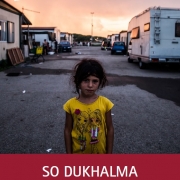
So Dukhalma – What makes me suffer. The inner disadvantage of Roma young people and families in institutional settlements

 
A minor who has been born and brought up in a mono-ethnic and overcrowded space, a minor who has experienced repeated evictions, for whom blazes and fires are common events, a minor who has no access to basic services and who suffers discrimination on a daily basis – how can such a young person live his or her experience? How do these circumstances condition such a person’s inner world, and how do they impinge on the family?
These are the questions that have guided the So Dukhalma research.
Download the report

In Giugliano, a new Roma ghetto

Associazione 21 luglio expresses its deep concern at the project of building an “eco-village” to house the approximately 250 Roma currently living in the settlement of Masseria del Pozzo in Giugliano, province of Naples.
This project, born out of an agreement between the Municipality of Giugliano, the Region of Campania and the Minister of the Interior, would inevitably lead to a reiteration of the spatial segregation on ethnic grounds and the violation of human rights of people who have already been the object of discriminatory policies. These policies confine them to a noxious area neighbouring a landfill, with high levels of pollution due to the verified presence of toxic waste, and to sub-standard living conditions.
Moving the Roma inhabitants of Masseria del Pozzo to the new so-called “eco-village” underlines once again how, when addressing the Roma housing problem, the local and national authorities take only an emergency approachneglecting any form of medium or long term planning. In fact, the same approach was taken in 2013, when the authorities of Giugliano moved the Roma people, forcibly evicted from informal settlements nearby, to the formal settlement of Masseria del Pozzo. This operation excluded those affected from the decision-making process and cost circa 400,000 euros.
While on the one hand the Associazione 21 luglio considers the gradual closure of the ghetto of Masseria del Pozzo a positive development from the perspective of the National Strategy for the Inclusion of Roma people, approved by the Italian government in 2012, it also fears that transferring the Roma onto a new “eco-village” would only bring about the birth of another “mega-camp” (the camp has the potential to house many more Roma people, as the related documentation shows). This could bring about a segregation on an ethnic basis which de facto excludes men, women and children from any possibility of social inclusion, as shown already by many other experiences in Italy.
Amongst other things, the project would have a high economic cost: around 1,3 million euros that, divided per 44 family units affected, amounts to 30,000 euros per family. This is a sum which could allow the authorities to draw on a broad range of other housing solutions which, unlike the one proposed, would allow for medium or long-term planning. These alternative solutions would not maintain the housing issues for Roma people on a parallel track in regards to the general population.
One of the unclear points in the project is linked to the temporary character with which the authorities have defined the intervention for the placement of Roma people in the new “eco-village”. Thirty years of “camp politics” in Italy – as the Associazione 21 luglio underlines – have shown how this type of operation, born to be temporary, has ended up transforming into de facto permanent housing solutions, with a concurrent deterioration of the quality of housing itself.
This is the case, just to cite one example, of the “La Barbuta Camp”, born as a temporary solution in 2012 and ruled discriminatory based on ethnic grounds by the Civil Court of Rome on May 30th, 2015, following a legal action taken by Associazione 21 luglio and ASGI (Association for Legal Studies on Migration).
Associazione 21 luglio hopes thus that the Municipality of Giugliano, the Region of Campania and the Minister of the Interior, aware of the project of the “eco-village” being unsustainable economically and from a human rights point of view, can promptly change the decision made and convert the operations towards a solution that, starting from the inescapable gradual closure of the settlement of Masseria del Pozzo, will promote a real and efficient inclusion of the Roma community of Giugliano.
Strong doubts on the project have also been expressed by the President for the Commission for Human Rights of the Italian Senate, Luigi Manconi, according to whom “in the way it has been conceived, the eco-village risks ending up not representing a solution, but rather becoming once again a temporary operation destined to fail.”
Traduzione dall’italiano di Mira Peliti

Associazione 21 luglio ETS - Largo Ferruccio Mengaroni, 29, 00133, Roma - Email: info@21luglio.org - C.F. 97598580583 - Privacy Policy - Cookie Policy